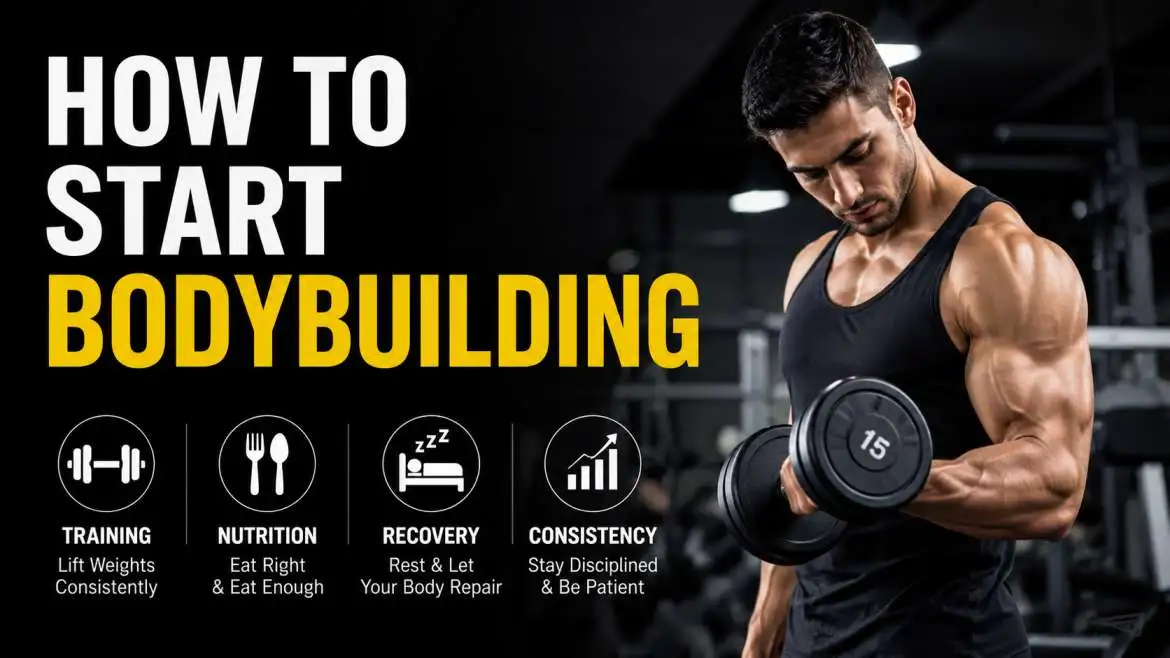
Have you ever thought of why the largest bodybuilders are so strong as well? It is not just a case of creating an impressive physique but it is on a base of actual power. This is a guide that dissects the precise way in which Strength training for bodybuilding and which makes the otherwise difficult science so easy and easy to follow.
You can be a beginner or you can be ready to leave the plateau and become even stronger but you need to comprehend this strong bond and you will get a lot of muscles and results.
Strength Training for Bodybuilding: More Than Just Lifting Heavy

It is also believed that bodybuilding is only concerned with the pumping of the body and a large number of reps. But genuine increase of muscles is closely tied to strength. Put simply, two types of training exist: hypertrophy training (to increase the size of muscles) and strength training (just to enhance pure power).
They work together. Strength training program educates your nervous system and your brain on the way of involving your muscle fibers more effectively. The best way to think of it is to upgrade the software of your body so that it is able to take heavier weights and it is this weight that will compel your muscles to expand in size with time.
It is this neural agility, as fitness guru Anthony O’Reilly, CPT, explains that makes someone with smaller muscles be able to lift more than the larger person on some occasions.
You may also read :- Strength Training Workouts for Muscle Growth
The Powerful Link Between Strength and Size
And what is the rationale of a bodybuilder becoming stronger? The reasons are clear:
- Lift More, Grow More: When you increase your one-rep max on the core lifts, the consequence is that you will be able to use heavier weight in your traditional hypertrophy workouts, which will provide a higher growth stimulus.
- Establish a Strong Base: Strength creates strong joints, tendons and ligaments and this is used to avoid injuries during the high volume bodybuilding sessions.
- General Health: According to studies, regular strength training is an effective method of increasing bone density, increasing metabolism, and even improving mental health.
Building Blocks of a Bodybuilder's Strength

There are some principles of bodybuilding strength training. These will master learning to make your workout count.
The Non-Negotiable Rule: Progressive Overload
You need to gradually demand a lot of your body to become stronger. This occurs as progressive overload. It does not necessarily imply the introduction of more weight. You can also:
- Add one more rep to your set.
- Complete an extra set.
- Minimize rest intervals between sets.
- Get better shape and discipline.
One of the most popular ways to do it is to increase the amount of weight (by adding 5 pounds) when you can comfortably do more than you are aiming to accomplish in a week.
Master the Big Lifts: Compound Exercises
Compound exercises are what form the strength base. These exercises such as squats and bench presses involve more than one muscle group and joint at the same time. They enable you to move the greatest weight and promote the greatest general growth of the muscles. They must be the essence of your fitness plan.
Train Your Mind: The Mind-Muscle Connection
It is not merely mechanical with bodybuilding. Your conscious attempt to experience the target muscle as it contracts with every repetition is the mind-muscle connection. This premeditated effort particularly in the lowering(eccentric) portion of a lift can result in enhanced muscle activation and development.
How to Structure Your Strength Training for Bodybuilding Program?
When you are aiming to be strong and not just big, the composition of your workout, your sets, your reps, your rest, varies.
The Strength Formula: Sets, Reps, and Rest
To maximize pure strength, the following recipe is not the usual bodybuilding exercise:
| Training Goal | Repetition Range | Sets per Exercise | Rest Between Sets |
|---|---|---|---|
| Maximal Strength | 1-5 reps | 3-5 | 3-5 minutes |
| Functional Strength/Hypertrophy | 6-12 reps | 3-4 | 60-90 seconds |
| Muscle Endurance | 15+ reps | 2-3 | 30-60 seconds |
In order to gain strength in bodybuilding, a combination strategy is frequently the most effective: your basic compound exercises (squats, deadlift, overhead press) are to be done in the lower number of reps, higher weight zone to gain strength. Next, overlay them with accessory lifts and isolation exercises with the 8-12 range of rep to add size and detail to the muscles.
Organizing Your Week: Workout Splits
The way you divide your training throughout the week is referred to as a workout split. A good split enables the muscles to rest and then train them often enough so that they develop. The Push/Pull/Legs (PPL) split is a popular and actually good split to use when combining strength and size together.
The following is what a weekly PPL routine may resemble:
- Day 1: Push (Chest, Shoulders, Triceps)
- Day 2: Pull (Back, Biceps)
- Day 3: Quadriceps, Hamstrings, Calves, Legs.
- Day 4: Rest or Active Recovery
- Day 5: Push (Repeat, using other exercises/variation/intensity)
- Day 6: Pull (Repeat)
- Day 7: Rest
This program exercises every major muscle group two times per week, which is optimal in building muscle.
Your First Steps: A 4-Week Blueprint
This is a simple, condensed 4-week program that will be the best way to start a strength and size training program. It is dedicated to the full-body exercises and the compound movement to create a strong foundation.
Week 1 & 2: Foundation
- Training 3 days in a week (e.g. Monday, Wednesday, Friday).
- Do 3 rounds of 10-12 reps of each workout.
- Concentrate on perfect form education.
- Sample Exercises: Goblet Squats, Dumbbell Bench Press, Bent-over Rows, Leg Curls, Overhead Press, Planks.
Week 3 & 4: Building
Additional training days of 4 per week upper/lower.
- Upper Day: 3-4 sets of 8-10 reps of exercises of pushing and pulling.
- Lower Day 3-4 sets of 8-10 squats and deadlifts and 12-15 leg accessories.
- Begin the use of progressive overload when the highest rep is not challenging.
Fueling Growth and Healing

Without the appropriate fuel and rest you cannot create a good body. The building blocks are in the form of nutrition and the growth is done when one is at rest.
Nutrition to build Muscle: It is important to have a balanced intake of protein (to build muscles), carbohydrates (to provide energy to muscles) and healthy fats (to promote hormone activity). The easiest one to start with is to consume a protein source and carbs within one hour after working out.
The Power of rest: You build muscles when you rest not when you train. Strive to have 7-9 hours of good sleep every night. There should always be a minimum of 1-2 days of complete rest per week so that your central nervous system and muscles can rest completely.
Start Building Your Foundation Today
Strength training for bodybuilding out is the shrewd, feasible way to a more capable and strong physical make-up. It’s not approximately chasing the heaviest single lift at the cost of everything else. Instep, it’s approximately building a flexible, competent body that can securely handle the seriously preparing required for marvelous growth.
Remember, the travel begins with a single rep. Center on frame, grasp the standards of dynamic over-burden, and never belittle the control of great nourishment and great rest. Your stronger—and bigger—future awaits.
Frequently Inquired Questions
1. Can I construct muscle without getting stronger?
While it's conceivable at first, long-term muscle development in the long run requires you to get more grounded. Expanding the weight you lift over time (dynamic over-burden) is the essential driver of proceeded muscle growth.
2. How frequently ought to I test my one-rep max (1RM)?
For bodybuilders, testing your genuine 1RM is not essential and can be hazardous. It's superior to calculate it based on the weight you can lift for 3-5 reps. You can re-evaluate these calculations each 8-12 weeks as you get stronger.
3. I’m a apprentice. Ought to I begin with quality or hypertrophy training?
Start with a crossover approach that educates you the major lifts with great frame. A full-body workout performed 3 times a week, centering on 8-12 reps, is an great way to construct introductory quality and muscle simultaneously.
4. Why am I not getting stronger?
The most common reasons are a need of dynamic over-burden, inadequately protein/calories, destitute rest, and not taking rest days. Overtraining can moreover weakness your central anxious framework, making you weaker. Survey your program, nourishment, and recuperation propensities.